 가게
Wearable iBeacon Technology: Improving Personnel Tracking and Workplace Safety
Introduction
In large and complex workplaces, knowing where people are can directly impact safety, efficiency, and emergency response. During a factory incident, medical emergency, or large-scale event, organizations need to quickly identify personnel locations and coordinate the right response at the right time.
하지만, many businesses still rely on traditional methods such as manual attendance, access control records, or visual supervision. While these approaches provide basic information, they often lack real-time visibility, making it difficult to locate employees during emergencies, monitor critical areas, or optimize workforce coordination.
이러한 과제를 해결하기 위해, more organizations are adopting Real-Time Location Systems (RTLS) 그리고 블루투스 저에너지 (BLE) 기술. Among BLE-based location solutions, wearable iBeacons provide a practical approach by combining low-power connectivity, flexible deployment, and reliable personnel tracking capabilities. This article explores what a wearable 아이 비콘 is, why businesses adopt it, its key applications, and how to choose the right solution.
What Is a Wearable iBeacon?
A wearable 아이 비콘 는 BLE-enabled device designed for personnel tracking applications. It is typically worn as a wristband, badge, or ID tag and periodically broadcasts 블루투스 signals to nearby receivers, such as gateways or smartphones.These signals enable real-time personnel visibility and support location-based applications without requiring complex wiring or high power consumption.
Unlike GPS, which is mainly used for outdoor navigation, wearable iBeacons are optimized for indoor positioning and proximity detection. Thanks to BLE technology, they consume very little power and can operate for years on a single battery, making them well suited for long-term personnel tracking deployments.
Wearable iBeacons are commonly available as wristbands, badges, or ID tags, allowing them to integrate naturally into daily operations across factories, 병원, office buildings, 학교, and other facilities. Instead of continuously transmitting location data, they periodically broadcast BLE advertising packets that can be detected by nearby receivers.
Compared with fixed beacons that identify specific locations, wearable iBeacons focus on the movement of people. This allows organizations to answer important operational questions, such as where employees are during an emergency, whether someone has entered a restricted area, or how workforce movement can be optimized to improve safety and efficiency.
Why Businesses Are Turning to Wearable iBeacon Solutions
As workplaces become larger and more complex, organizations need more than traditional attendance systems or access records to manage their workforce effectively. Real-time personnel visibility has become an important capability for improving safety, optimizing operations, and reducing response times.
Unlike manual processes, wearable iBeacons provide continuous personnel visibility through 블루투스 저에너지 (BLE) 기술. This allows organizations to quickly identify personnel locations, improve coordination, and respond more effectively without significantly changing existing workflows.
The growing adoption of wearable 아이 비콘 solutions is driven by several key business benefits.
Improving Personnel Visibility and Coordination
In factories, 병원, and large facilities, employees are constantly moving between different areas. Wearable iBeacons help organizations maintain real-time awareness of personnel locations, making it easier to coordinate teams, allocate resources, and improve daily operations.
Enhancing Safety and Emergency Response
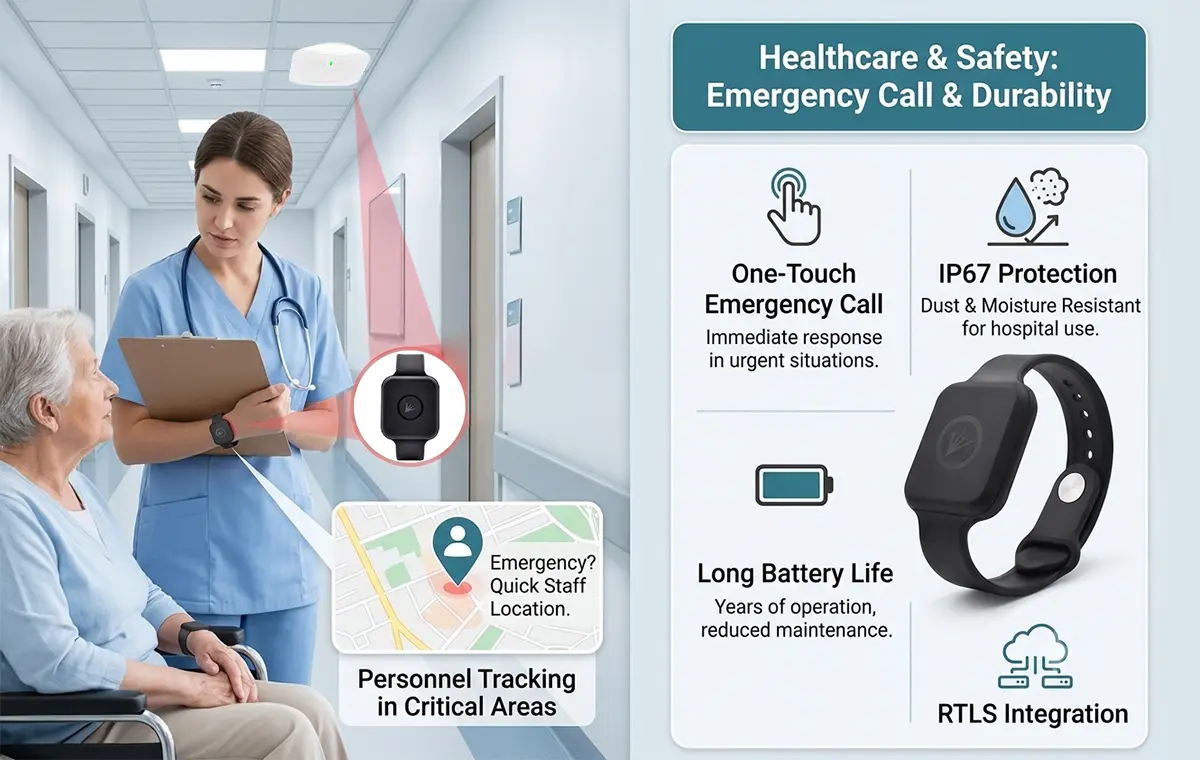
Workplace safety is a major driver for wearable location technology. 긴급상황 발생 시, wearable iBeacons can help organizations identify the last known location of personnel, support faster response procedures, and improve safety management in high-risk environments.
Reducing Operational Costs and Simplifying Deployment
Compared with more complex positioning solutions, BLE-based wearable iBeacons offer low power consumption, flexible deployment, and easy integration with existing RTLS or IoT platforms. Their long battery life and scalable design help reduce maintenance requirements and lower the total cost of ownership for large-scale deployments.
Supporting Data-Driven Operations
Beyond real-time tracking, wearable iBeacons provide valuable location data that helps organizations understand workforce movement and improve resource utilization. By turning location information into actionable insights, businesses can optimize workflows and make more informed operational decisions.

Key Applications of Wearable iBeacon Technology
Although wearable iBeacons are built on the same 블루투스 저에너지 (BLE) 기술, their value varies across different operational environments. By providing real-time personnel visibility and indoor positioning capabilities, wearable iBeacons help organizations improve safety, coordination, and operational efficiency in various industries.
스마트 제조
Manufacturing facilities often involve complex workflows, moving personnel, and safety-critical environments. Wearable iBeacons enable real-time employee visibility across production areas, helping supervisors locate workers, coordinate maintenance teams, and monitor access to restricted zones. Integrated with RTLS and Industrial IoT platforms, wearable iBeacons support smarter factory operations and more efficient workforce management.
Healthcare and Elderly Care
In healthcare environments, fast communication and accurate personnel coordination are essential. Wearable iBeacons help medical teams quickly identify staff locations during urgent situations, improving response efficiency and collaboration. In elderly care facilities, they support caregiver coordination and resident safety, while their lightweight design and long battery life make them suitable for continuous daily use.
Events and Public Venues
Large venues such as exhibitions, conferences, and sports facilities require effective coordination among organizers, security personnel, and temporary staff. Wearable iBeacons provide real-time location awareness, helping managers quickly assign tasks, dispatch support teams, and maintain operational visibility. 긴급상황 발생 시, location information can also support faster response and improved personnel accountability.
How to Choose the Right Wearable iBeacon
Selecting the right wearable iBeacon requires more than comparing individual specifications. The ideal device should match your application requirements, 배포 환경, and long-term operational goals.
When evaluating wearable iBeacon solutions, businesses should consider several key factors to ensure reliable performance and efficient deployment.
Battery Life and Power Efficiency
Battery life is one of the most important factors for large-scale wearable iBeacon deployments. Since these devices are often used by employees, patients, or visitors for extended periods, frequent battery replacement can increase maintenance costs and affect system availability.
A low-power BLE design with optimized transmission settings helps extend operating time, reduce maintenance workload, and support continuous tracking in environments where reliable visibility is essential.
Durability and Environmental Protection
Wearable iBeacons are exposed to daily use, making durability a critical consideration. Depending on the application, devices may need to withstand dust, 수분, cleaning processes, or accidental impacts.
Choosing a wearable iBeacon with suitable protection features helps ensure stable operation in different environments, from healthcare facilities to industrial workplaces.
System Compatibility and Scalability
A wearable iBeacon is usually part of a larger tracking ecosystem that includes BLE gateways, RTLS platforms, mobile applications, or cloud-based management systems.
Before deployment, businesses should evaluate compatibility with existing infrastructure, configuration flexibility, firmware update support, and integration capabilities. A scalable solution makes it easier to expand deployments as operational needs grow.
Comfort and User Experience
Since wearable iBeacons are designed for daily use, comfort and usability directly affect adoption. Lightweight designs, secure wearing methods, and practical form factors help ensure that employees or patients are willing to use the devices consistently.
The best wearable iBeacon solution is not only technically reliable but also easy and comfortable for people to wear.
Future Trends in Wearable iBeacon Technology
As businesses continue investing in smart workplaces and connected infrastructure, wearable iBeacon technology is expected to play a greater role in indoor positioning and location-based solutions.
Future wearable iBeacon systems will go beyond basic proximity detection by working together with Real-Time Location Systems (RTLS), BLE gateways, IoT platforms, and data analytics tools. This integration will help organizations gain more accurate personnel visibility, optimize workflows, and improve safety management.
Another important trend is the demand for more flexible and interoperable solutions. Businesses are looking for wearable iBeacons that can easily integrate with existing systems and scale as operational requirements grow. Support for open protocols, 펌웨어 업데이트, and seamless connectivity will become increasingly important.
With advances in low-power wireless technology, sensor integration, and intelligent analytics, wearable iBeacons will continue evolving from simple tracking devices into essential components of indoor positioning ecosystems, enabling safer workplaces and smarter operations.
결론
As businesses continue to prioritize safety, efficiency, and connected operations, wearable iBeacon technology is becoming an important solution for improving personnel visibility and location-based management.
Choosing the right wearable iBeacon requires more than evaluating specifications. Factors such as battery life, durability, 연결성, and system compatibility all play an important role in building a reliable and scalable personnel tracking solution.
Designed for personnel tracking and wearable location applications, 피지컴 FSC-BP107D combines 블루투스 5.1 연결성, long battery life, IP67 protection, and support for multiple 봉홧불 프로토콜, including iBeacon, 에디스톤, and AltBeacon. With a compact wearable design and reliable BLE performance, it provides a practical foundation for organizations building safer and more efficient location-based systems. It is designed for organizations looking to deploy scalable BLE-based personnel tracking and indoor positioning solutions.
By selecting the right BLE wearable solution, businesses can improve workplace safety, optimize operations, and create more connected environments.