Negozio

LE Audio vs Classic Bluetooth Audio: Auracast, A2DP, Latenza, and Which Module to Use
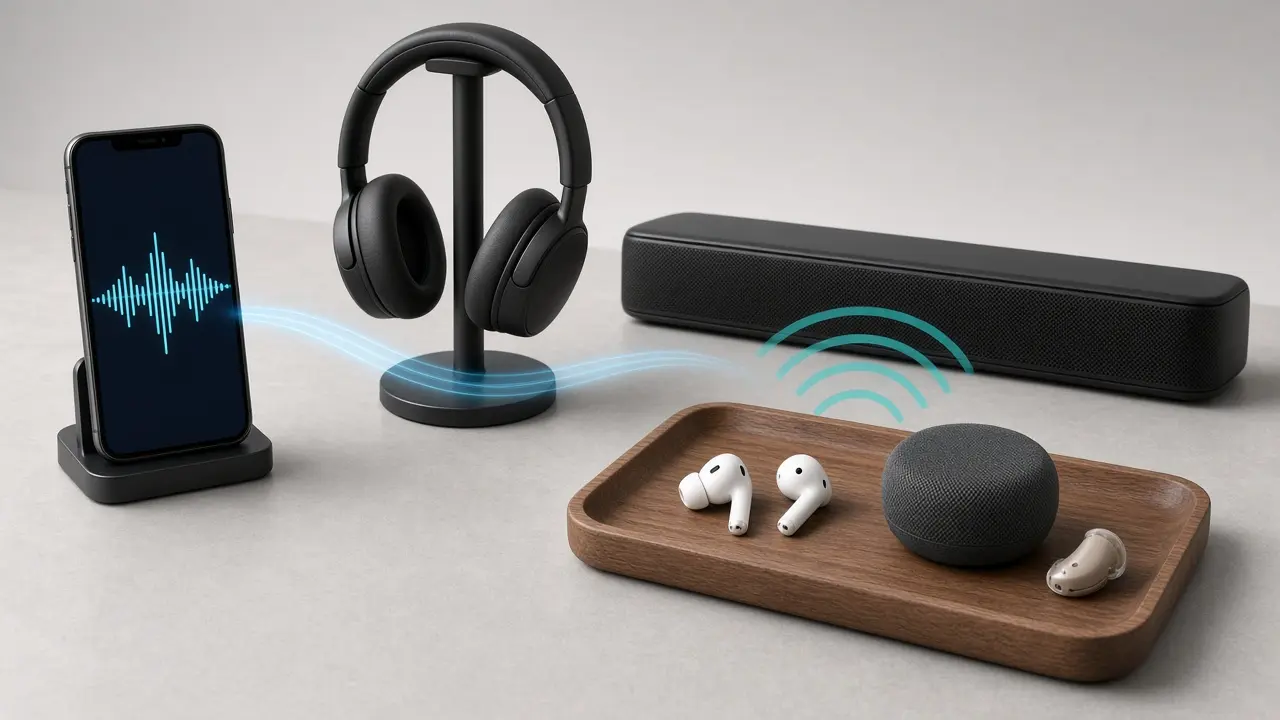
LE Audio is the audio system built on Bluetooth Low Energy. Classic Bluetooth Audio is the system behind A2DP music and HFP calls. They are not two bit-rate settings of the same link. A phone, TV, or module supports LE Audio only when the profiles are implemented. Printing "Bluetooth 5.2" or "Bluetooth 5.3" on the box does not mean Auracast, LC3, or multi-stream stereo will work. Use Classic Bluetooth Audio when the product must connect to the phones, TVs, and cars people already own. Use LE Audio when the product needs separate left and right streams, lower bit rate for the same speech quality, hearing-aid profiles, or a one-to-many broadcast. Most designs shipping through the next product cycle need both, on a dual-mode module. This page is the architecture comparison. Codec-by-codec numbers for SBC, CAA, aptX, LDAC, LHDC, and LC3 are in the Bluetooth audio codec comparison. LE Audio vs Classic Bluetooth Audio Classic Bluetooth Audio LE Audio Radio Bluetooth BR/EDR Bluetooth Low Energy, with Isochronous Channels from Core Spec 5.2 Music profile A2DP, plus AVRCP for play/pause and track Basic Audio Profile (BAP) over CIS or BIS Calls HFP, usually CVSD or mSBC Telephony and Media Audio Profile (TMAP) over LE Audio Mandatory codec SBC LC3 Optional codecs AAC, aptX family, LDAC, LHDC, others Vendor codecs may exist; LC3 is the one every LE Audio device must share Typical topology One source paired to one sink. Stereo TWS often uses a vendor relay between the buds Connected streams (CIS) or a broadcast (BRI / Auracast) Pairing Required for A2DP and HFP Required for a personal CIS. Not required to hear an open Auracast broadcast Bit rate, music SBC often 192–328 kbps. Hi-res codecs go much higher LC3 commonly run well below SBC for similar speech and music quality Latency Often 100–250 ms. aptX Low Latency can be near 40 ms if both ends support it 7.5 ms o 10 ms frames. End-to-end delay depends on presentation delay and buffering Hearing aids Proprietary paths such as Apple MFi and Android ASHA Hearing Access Profile on LE Audio Public audio One paired speaker or headphone Auracast broadcast to many receivers in range What still fails A sink that only implemented LE Audio will not play A2DP A phone that only has Classic Audio will not start an LE Audio stream Classic Audio and Bluetooth Low Energy already coexist in dual-mode chips. BLE on those chips has long been used for battery status, app control, and sensors. That control channel is not LE Audio. LE Audio adds isochronous audio streams and a new set of profiles on top of BLE. A2DP vs LE Audio A2DP (Profilo di distribuzione audio avanzato) is how Classic Bluetooth sends stereo music. The phone encodes PCM with SBC or a licensed codec, packetizes it, and the headphone decodes it. AVRCP rides alongside for buttons and metadata. A2DP is mature, and almost every phone, laptop, car head unit, and Bluetooth speaker from the last decade can sink or source it. A2DP is also a one-sink design. True wireless earbuds faked stereo for years by receiving on one bud and relaying to the other, or by sniffing the same packets. The relay costs power and adds a failure point when the two buds are far apart around the neck. The stream is also one blob of stereo, not two streams the source can treat independently. LE Audio does not use A2DP. Audio rides on Isochronous Channels defined in Bluetooth Core 5.2: A Connected Isochronous Stream (CIS) is a scheduled stream inside an existing connection. A Broadcast Isochronous Stream (BRI) is a stream anyone in range can synchronize to. The profile on top is BAP, not A2DP. If a datasheet says "A2DP, AVRCP, HFP" and never mentions BAP, LC3, or Auracast, the module is Classic Audio, even if the Bluetooth version is 5.3 O 5.4. Best for A2DP: car kits, legacy speakers, cost-down Classic headsets, any SKU whose first requirement is "works with every phone in the field." Best for LE Audio: new TWS, apparecchi acustici, broadcast receivers, and transmitters that must feed many listeners from one source. Not a drop-in replacement. A Classic-only sink and an LE-Audio-only source will not play music to each other. Transition products implement both. That is what a dual-mode part such as the FSC-BT2002RV (RTL8761CTV, Classic and LE Audio, transmit and receive) is for. Auracast vs Classic Bluetooth sharing Auracast is the Bluetooth SIG consumer name for LE Audio broadcast. The radio piece is the BIS. Three roles show up in product specs: Auracast Transmitter. The TV, telefono, PA mixer, gym TV, or dedicated dongle that encodes LC3 and advertises a broadcast. It can be open, or locked with a broadcast code. Auracast Receiver. Earbuds, apparecchi acustici, altoparlanti, or a receiver module that synchronize to that BIS and decode LC3. They do not each pair to the TV. Auracast Assistant. Usually a phone app. It scans broadcasts, shows the name and language, and tells the user's receiver which stream to join. The assistant is how a traveler picks "Gate B12" instead of the sports bar next door. Classic sharing never worked this way. A TV with one A2DP connection serves one headphone. Bars that want several private listeners either run an RF transmitter on a non-Bluetooth band, or they pair and unpair. Auracast is the Bluetooth-native version of that public feed: one transmitter, many receivers, each at its own volume, including hearing aids on the standard Hearing Access Profile. Range is still 2.4 GHz radio range, not a promise of a whole stadium from a 0 dBm module. Walls, Wifi, and body loss apply. "Unlimited receivers" means there is no pairing slot count. It does not mean unlimited distance. Feasycom's LE Audio solution is built around this split: take audio in over Classic Bluetooth from a phone, laptop, or TV, then send it out as an Auracast broadcast. Public TVs, meeting rooms, and personal audio sharing are the applications listed on that page. A receiver-side module for the listening product is the FSC-BT1038A (QualcommQCC3083, Bluetooth 5.4 Classic and LE Audio receiver). The sibling FSC-BT1038B uses QCC3084. Best for Auracast: TVs in gyms and airports, lecture halls, silent stages, tour systems, assisted listening. Not ready for Auracast alone: a product that must ship next month into a market where the customer's phone is still Classic-only and there is no assistant app in the plan. Keep A2DP as the fallback. CIS vs BIS These two acronyms are the whole topology choice. CIS (Connected Isochronous Stream) belongs to a connection. The source and the sink are paired. A Connected Isochronous Group (CIG) holds the streams that share timing. A stereo TWS link is typically two CIS streams, one per ear, sent directly by the phone. Each bud receives its own channel. There is no relay bud. The source can also send a mono voice stream for a call on the same timing grid. If the link drops, the devices still have a connection to re-establish. BRI (Broadcast Isochronous Stream) has no per-listener connection. The transmitter schedules packets at a fixed interval. Receivers sync to the timing and decode. A Broadcast Isochronous Group (BIG) can carry more than one BIS, for example stereo left and right, or two languages. Anyone who can hear the advertisement and who has the broadcast code, if there is one, can join. The transmitter does not know how many receivers are listening, and it does not get per-receiver ACKs the way a CIS does. Packet loss is handled by retransmission inside the broadcast schedule, not by a listener saying "send that again." CIS BIS / Auracast Connection Yes No pairing per listener Who uses it Phone to earbuds, phone to hearing aids, private one-to-one TV to a room, gate announcement, shared music Back channel Control and link-layer feedback exist on the connection Broadcast is one way. Control goes through the Assistant or a separate connection Privacy Encrypted with the connection Open, or a broadcast code Failure mode A bud out of range loses its own stream A receiver out of range just stops hearing the broadcast Module implication Sink or source must implement BAP unicast Transmitter and receiver must implement Public Broadcast Profile (PBP) Pick CIS for a personal device. Pick BIS for a place. A module that is only a peripheral GATT device, with no ISO support, can do neither. LC3 vs SBC, and LC3 vs LC3plus LC3 (Low Complexity Communication Codec) is the mandatory LE Audio codec. SBC is the mandatory A2DP codec. They do not negotiate with each other. An A2DP phone will not "fall back to LC3," and an LE Audio phone will not "fall back to SBC" on the LE Audio stream. Fallback means the phone starts the other audio system, Classic or LE, if the product implements both. What the Bluetooth SIG's listening tests have reported, and what matters for a battery: LC3 can match or beat SBC at roughly half the bit rate. SBC stereo in phones is often 192–328 kbps, with a practical ceiling near 345 kbps. LC3 frames are 7.5 ms o 10 SM, sample rates run from 8 kHz to 48 kHz, and the usual operating range cited for a 10 ms frame is about 16–320 kbps. Speech products often sit near 32 kbps. Music products often sit in the 96–160 kbps region per configuration, not at LDAC's 990 kbps. That is a power win only if the radio schedule is actually shorter. A high-reliability LE Audio configuration with short intervals and many retransmissions can erase the bit-rate saving. Measure current with the codec, interval, and retransmission count you will ship, on the antenna you will ship. LC3plus is not LC3. LC3plus is a Fraunhofer codec (ETSI TS 103 634) with higher sample rates and a low-latency mode used in some DECT and broadcast systems. Bluetooth LE Audio does not require it, and a datasheet that says LC3 is not claiming LC3plus. If a customer asks for 96 kHz over Bluetooth, that request still belongs to Classic hi-res codecs such as LDAC or LHDC, which are compared in the codec article. Best for LC3: apparecchi acustici, Auracast, TWS that want two streams and a long battery life, voice-first wearables. Not a reason to drop SBC: any design that still has to answer an A2DP connection from an older phone. Bluetooth 5.2 contro 5.3 contro 5.4 does not mean LE Audio Core Spec 5.2 added Isochronous Channels. That is the radio feature LE Audio needs. Nucleo 5.3 added connection subrating and other controller features that help a duty-cycled link sleep. Nucleo 5.4 added Periodic Advertising with Responses, which shows up more often in electronic shelf labels than in headphones. None of those version numbers turn the feature on. A firmware image can be qualified as Bluetooth 5.4 and still ship without BAP, without LC3, and without PBP. The questions to put on a module checklist are: Does the controller support CIS, BRI, o entrambi? Which host profiles are in the firmware: BAP, TMAP, PBP, Hearing Access Profile? Is LC3 in the build, and is it on the source, the sink, o entrambi? Is Classic A2DP/HFP still in the same image? Has that combination passed Bluetooth qualification for the product, not just for the bare module? FSC-BT1211 is a small Bluetooth 5.3 LE Audio module. FSC-BT1038A and FSC-BT1104QI are Bluetooth 5.4 receiver modules (QCC3083 and QCC3095). The version on the label tells you the core spec ceiling. The words "LE Audio receiver" or "Classic and LE Audio" tell you whether audio profiles are actually there. LE Audio latency vs Classic Bluetooth latency People start to notice lip-sync problems somewhere around 70 ms of audio delay relative to video. Gaming and camera viewfinders are stricter. Music listening is not. Classic A2DP delay is dominated by the encode frame, the phone's buffer, and the sink's jitter buffer. SBC and AAC links commonly land between about 150 ms and 250 SM. aptX Low Latency is the Classic exception, around 40 SM, and only when the phone and the headset both enable it. A headset that supports aptX Low Latency still sits at SBC delay if the phone never offers aptX. Those codec delays are tabulated in the codec comparison. LE Audio delay is dominated by frame length and presentation delay. UN 7.5 ms frame gives the scheduler a shorter packet cadence than a 10 ms frame. Presentation delay is negotiated. It is the sink telling the source how long it needs to buffer, mix, and play. Add retransmission for a noisy 2.4 GHz room and the number moves again. Treat "under 40 SM" as something a low-latency firmware can reach, not as a property of every LC3 logo. Treat music-mode buffering of well over 40 ms as normal when the designer chose robustness over lip-sync. Use Delay that usually feels acceptable Practical system Music listening 100–200 ms is fine A2DP SBC/AAC, or LE Audio with a deep jitter buffer Video, lip-sync Keep audio inside about 70 ms of the picture LE Audio with a short presentation delay, or aptX Low Latency on Classic Rhythm gaming, camera monitoring As close to 20–40 ms as the link allows LE Audio 7.5 ms frames, or a Classic low-latency codec, both ends enabled Live speech, hearing assistance Low enough that the talker's mouth matches the voice, plus very high reliability LE Audio CIS or a broadcast with enough retransmissions that dropouts do not punch holes in words If the product is a TV transmitter, latency has to be measured from the HDMI or line-in timestamp, not from the module's codec delay alone. Video processing in the TV often adds more delay than Bluetooth does. LE Audio hearing aids vs MFi and ASHA Hearing aids used to speak two private dialects. Apple devices used Made for iPhone. Android phones used ASHA (Audio Streaming for Hearing Aids). Each path needed its own qualification, and a hearing aid that did one well could still be invisible to the other phone. LE Audio replaces that split with the Hearing Access Profile. The same LC3 stream model used for earbuds carries the hearing-aid audio. Auracast then covers the other half of the use case: the airport TV, the theater, the ticket window, the lecture. The listener does not pair to the building. An assistant on the phone selects the broadcast, and the hearing aid joins it. This does not retire MFi or ASHA on day one. Installed phones will keep using the path they already have. A hearing-aid design that has to serve both a five-year-old handset and a new one needs the legacy path and LE Audio, or a very honest compatibility list. What it should not do is treat a generic BLE connection as an audio path. BLE notifications are not a hearing-aid audio stream. Classic TWS relay vs LE Audio multi-stream A Classic TWS bud usually receives A2DP and forwards audio to the other bud over a second link the phone does not control. Consequences that show up in returns: The relaying bud uses more current than the other one, so the case charge is uneven. Pulling the phone-side bud out of the ear to share it with someone breaks the pair. Antenna placement is a compromise, because one bud must hear the phone and the other bud. LE Audio multi-stream sends a CIS to each bud from the phone. Left and right can be different bit rates. Either bud can be the one that stays in when the other is back in the case. The phone's controller does the scheduling. The cost moves to the phone: both the handset and the buds must support LE Audio unicast. Until that is the default in the markets you sell to, the same earbuds still need an A2DP mode. A small dual-mode part for that class of design is FSC-BT1211. A Classic TWS receiver that is not an LE Audio design stays on a Classic audio module such as FSC-BT1026C (QCC3024). Forcing LC3 marketing copy onto a Classic-only module will not create the second stream. Auracast transmitter vs Auracast receiver The two products are different modules, different clocks, and different certifications. Transmitter. Audio enters on I2S, line-in, USB, or from a Classic A2DP source role. The device encodes LC3, builds a BIG, and advertises a broadcast name. It may also be the Classic sink in a bridge: phone connects with A2DP, the module re-encodes, the room hears Auracast. That bridge is the pattern described in the LE Audio solution. FSC-BT1058 (QCC5181, Bluetooth 5.3 Classic and LE Audio transceiver) and FSC-BT2002RV are the parts whose public titles say transceiver or TxRx, so they are the ones to evaluate when the product has to send. Ricevitore. Audio leaves on I2S or a codec DAC into an amplifier. The device scans or is pointed at a BIS by an assistant, syncs, and decodes. Headphones, altoparlanti, and hearing-aid dongles are receivers. FSC-BT1038A, FSC-BT1038B, and FSC-BT1104QI are titled as receiver modules. A transceiver can be firmware-limited to one role. Confirm the role in the firmware release you will flash, not only in the silicon family name. When Classic Bluetooth Audio is still the right design Stay on Classic, or ship Classic first, when any of these are true: The customer's phone, car, or TV list is dominated by devices you have already tested with A2DP, and LE Audio is absent from that test log. The product is a low-cost speaker or a motorcycle dashcam monitor whose buyers will not install an assistant app. The automotive solution still has to assume Classic inside the vehicle. The audio source is hi-res marketing: LDAC or LHDC at high bit rate. LE Audio LC3 is not that product. Compare those codecs separately, then decide whether the battery can pay for them. Certification time is short. Adding BAP, PBP, and a broadcast UI is a second qualification, not a checkbox on an existing A2DP listing. The RF environment is a factory floor already full of Wi-Fi, and the audio is a voice prompt. SBC at a modest bit rate, or a short LC3 voice stream, both work. The antenna and coexistence filter decide reliability more than the codec logo. Wi-Fi modules in the same enclosure need a coexistence plan either way. Move to LE Audio, with Classic kept as fallback, when the product is TWS, a hearing aid, a public transmitter, or a receiver that must join a broadcast. How to choose a Bluetooth audio module Work down this list in order. Skipping to the Bluetooth version number is how projects order the wrong tape. Role. Ricevitore, trasmettitore, or bridge (Classic in, Auracast out). Profiles in the firmware you will actually flash. A2DP/HFP, BAP, PBP, TMAP, Hearing Access Profile. Write the list into the requirements, not the brochure. Handset matrix. The ten phones and two TVs that sales named. Test Classic and LE Audio separately on each. Latency budget from the video or microphone timestamp to the speaker. Split it between host buffering and the module. Power at the real codec settings, measured on your antenna, not on the development board's coax. Interfacce. I2S, PCM, analog, USB, UART for the assistant or the host MCU. Licenses. aptX, LDAC, and LHDC are separate from LC3. LC3 comes with LE Audio. The others do not. Qualification. Module certification is not the finished product's listing if the antenna or the profile set changed. Product job Start here Earbud or speaker that must play A2DP today and LE Audio from new phones LE Audio modules, doppia modalità, for example FSC-BT1038A or FSC-BT1211 Classic TWS or hi-res sink, no broadcast requirement Classic audio modules, for example FSC-BT1026C TV dongle or PA feed that transmits A transceiver: FSC-BT1058 or FSC-BT2002RV Room system: phone connects with Classic, many headsets listen LE Audio solution Car, motorcycle, or other host that already has a Classic stack Dual-mode Bluetooth modules and the automotive solution Undecided on the radio family Bluetooth modules If the handset matrix and the role are already known, contact Feasycom with that list. Codec logos without the phone list are not enough to pick a module. Questions engineers actually search Is LE Audio the same as Bluetooth Low Energy? NO. Bluetooth Low Energy is the radio. LE Audio is audio profiles and LC3 running on Isochronous Channels over that radio. A BLE beacon, a BLE sensor, and a BLE module that only sends GATT data are not LE Audio products. Background on the radio itself is in Bluetooth Low Energy technology. Does Bluetooth 5.3 O 5.4 mean the device has LE Audio? NO. The version is the Core Spec revision. LE Audio is present only if CIS or BIS, LC3, and the audio profiles are in the firmware and in the qualification. What is Auracast? Auracast is broadcast LE Audio. One transmitter sends LC3 on a BIS. Many receivers can play it without each of them pairing. A phone often acts as the Auracast Assistant that lets the user pick the broadcast. Can Auracast work without pairing? An open broadcast can be heard without a Classic-style pair. Private broadcasts still need the broadcast code. A personal earbud stream that is a CIS is a normal connection, and that one does pair. Is LC3 better than SBC? At a given bit rate, LC3 is the stronger codec, which is why LE Audio can spend fewer kilobits on speech and music. SBC remains mandatory for A2DP, so a dual-mode product still decodes it. They are not alternatives inside one profile. What is the difference between LC3 and LC3plus? LC3 is the Bluetooth LE Audio codec. LC3plus is a different Fraunhofer codec with its own specification and higher-rate modes. Support for one is not support for the other. What is the difference between CIS and BIS? CIS is a connected stream to a paired device, used for TWS and private hearing-aid links. BIS is a broadcast stream, used for Auracast. CIS has a connection. BIS does not keep a connection per listener. What Bluetooth audio latency is low enough for video? Aim to keep audio within about 70 ms of the picture if lip-sync matters. Many A2DP SBC and AAC links are slower than that. LE Audio can be faster when the presentation delay is set short, and aptX Low Latency can be faster on Classic when both ends enable it. Can one module do Classic Bluetooth Audio and LE Audio? SÌ, if it is a dual-mode module whose firmware includes both stacks. Receiver examples include FSC-BT1038A and FSC-BT1211. A part listed only under Classic audio will not grow LE Audio because the PCB was respun. Do hearing aids need LE Audio? New designs use LE Audio and the Hearing Access Profile so one product can serve standard phones and Auracast venues. Older phones still expect MFi or ASHA. Check the phone list before deleting the legacy path.
Leggi l'articolo