 محل
How Bluetooth Low Energy (بليه) Beacon Work?
A Bluetooth beacon is a small device that broadcasts a short identifier over بلوتوث Low Energy (بليه). A nearby phone or gateway can hear that identifier, and the signal strength gives a rough idea of distance. The beacon does not pair with the phone, and it does not store who walked past.
That is the whole mechanism. This guide explains the packet formats, what actually limits range and battery life, and how Android and iOS handle a Bluetooth beacon today.
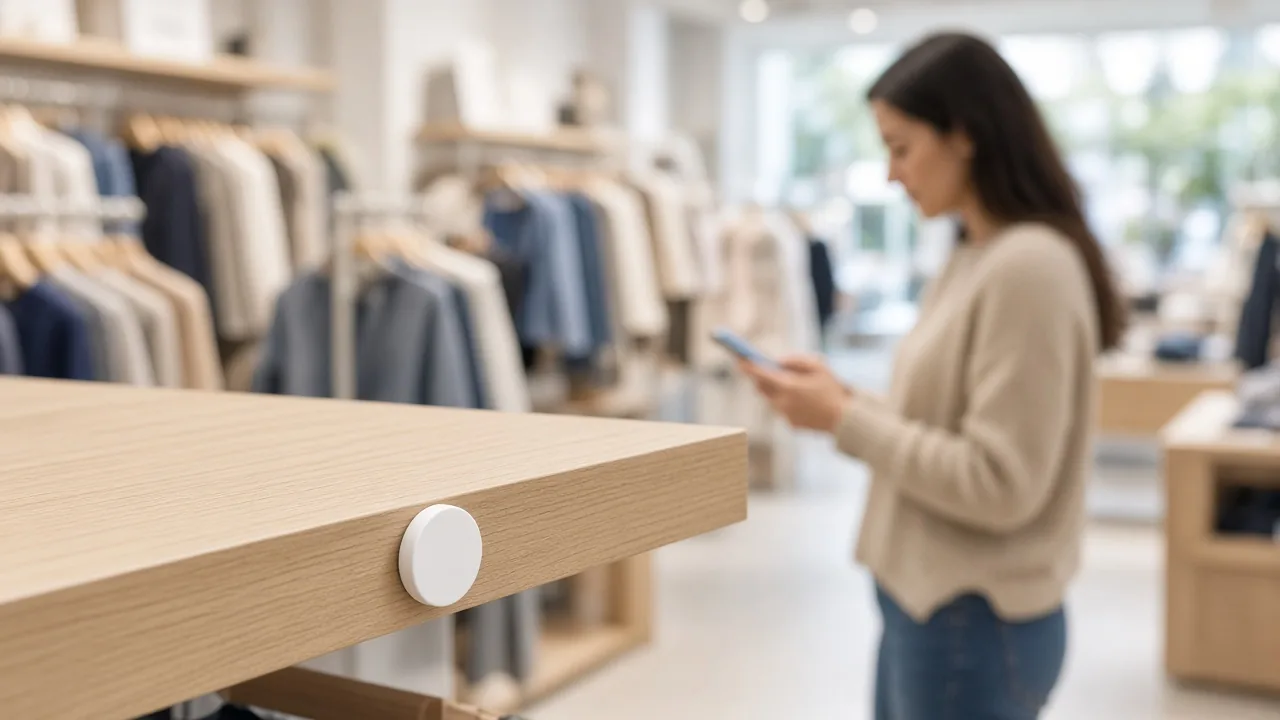
A Bluetooth beacon marks one spot. The app on the phone decides what that spot means.
What is a Bluetooth beacon?
A Bluetooth beacon, also called a BLE beacon or a proximity beacon, is a transmitter. It usually runs on a coin cell, AAA batteries, or USB power. On a fixed schedule it wakes up, sends one advertising packet, and goes back to sleep.
Beacons are sometimes described as surveillance devices that follow a phone’s owner. A beacon cannot do that by itself. It only broadcasts. A location is inferred later, and only if a separate system is listening: a store app on the phone, or gateways that report which tag they can hear. The beacon keeps no list of visitors.
It is not a GPS tracker either. It does not know its own coordinates. You assign the meaning of its ID in your app or platform, such as “this ID is the entrance” أو “this ID is wheelchair 14.”
Most فيزيكوم beacons advertise iBeacon, Eddystone (UID, URL, and TLM), and AltBeacon. Many of them can broadcast several of those frames at the same time.
How a Bluetooth beacon works

Three steps: the beacon broadcasts, a phone or gateway receives, and your software acts.
The sequence is the same in a shop, a hospital, or a warehouse.
1. The beacon broadcasts. It transmits on the three بليه advertising channels, 37, 38, و 39, in the 2.4 GHz band. A typical advertising interval is between 100 milliseconds and a few seconds. A shorter interval makes the beacon easier to notice, and it uses more battery.
2. The phone does not need to connect. A normal broadcast is one-way. The beacon does not ask for a name, an account, or a phone identity. Setup is a separate step. An app such as FeasyBeacon can connect briefly to change the interval, the transmit power, or the frame contents. Everyday operation is still just advertising.
3. A listener reads the ID and the RSSI. The listener is an app on a phone, or a fixed gateway. It reads the identifier in the packet and the received signal strength, called RSSI. A stronger RSSI usually means the listener is closer. Walls, people, and the way a phone is held can still swing the reading. Treat RSSI as a zone: immediate, near, or far. It will not give a distance in centimeters.
4. Software decides what the ID means. The identifier is useful because your system has a record for it. A retail app can open the page for that department. A gateway can report that asset tag 12 is near dock door B. With no record behind it, a beacon is only an anonymous radio ping.
Angle of Arrival is a different method. RSSI from a single beacon stays at zone level. Sub-meter results need locator anchors. Models such as the FSC-BP104D and FSC-BP110 can be used in that kind of اتفاقية الزراعة deployment, and the accuracy comes from the anchor network.
What is inside a Bluetooth beacon packet?
The radio frame is short. The useful part is an identifier, plus a few bytes that help the receiver estimate distance.
|
Format |
What it carries |
Where it is used |
|---|---|---|
|
A 16-byte UUID, Major and Minor numbers, and a calibrated power value (the expected RSSI at 1 meter) |
iOS region monitoring, and Android apps. Major and Minor usually mark a site and a point inside it. |
|
|
Eddystone-UID |
A 10-byte namespace and a 6-byte instance |
Cross-platform IDs, often read by gateways and Android apps |
|
Eddystone-TLM |
Battery voltage, temperature, and a count of packets sent |
Maintenance. It describes the beacon’s health, not a location. |
|
AltBeacon |
An open layout with an identifier and a reference RSSI |
The Android Beacon Library and custom scanners |
Eddystone-URL is still a valid frame. The beacon compresses a web address into the packet. That frame does not open the page on a phone by itself. Google shut down Nearby Notifications and the Physical Web in 2018, so Android no longer turns those URLs into system notifications. Use Eddystone-URL only when your own app or gateway is going to read it.
iBeacon is a packet format. The radio underneath is still BLE. One device can send an iBeacon frame, an Eddystone frame, or both. “iBeacon” names the contents. “Bluetooth beacon” names the device.
Bluetooth beacon, BLE module, and gateway
These three are easy to mix up, because all of them use BLE.
|
|
Bluetooth beacon |
بوابة |
|
|---|---|---|---|
|
Role |
A finished device that mostly advertises |
A component inside your product. It can advertise, connect, and exchange data. |
A scanner. It hears many beacons and forwards them to a server. |
|
Power |
Battery or USB |
Whatever powers the host product |
Mains power, so it can scan all day |
|
Typical job |
Mark a place, or travel with an asset as a tag |
Build a product that talks to a phone |
Asset tracking and indoor location when phones are not part of the system |
A beacon is a peripheral that advertises. A phone or a gateway is the central device that scans. The difference between those two BLE roles is covered in center mode and peripheral mode.
When the phone cannot be part of the system, as in a warehouse, a hospital, or a campus, put tags on the assets and gateways in the building. When a shopper’s own phone should react, that phone needs an app that scans.
Range, advertising interval, and battery life
In the open, current فيزيكوم models are often specified in the hundreds of meters. Indoors, shelves, walls, and bodies bring the reliable distance down to a room or an aisle. The figure that matters is the range in your building, measured with the phone or gateway you will actually deploy.
Three settings push range and battery life in opposite directions.
-
Transmit power. The FSC-BP104D can be set from -19.5 dBm to +2.5 dBm. Higher power reaches farther and uses the battery faster.
-
Advertising interval. On that same beacon the interval can be set from 100 ms to 10,000 ms. The default is 1,300 ms, which is one reason a battery life of up to 10 years is possible. An interval of 100 ms is easier for a passing phone to catch, and it costs much more energy.
-
Who is listening. A phone in a pocket hears less than a gateway mounted in the open, even when the beacon is unchanged.
A few models show how the hardware follows the job.
-
FSC-BP104D is an IP67 beacon with two replaceable AAA cells, up to 400 m in an open area, and up to 10 years at the default interval. It fits warehouses and assets that see dust or rain.
-
FSC-BP110 is a flat CR2032 beacon, up to 500 m in the open and about 3 years at its default interval, with an optional button and motion sensor. It fits check-in, patrol, and a one-press alert.
-
FSC-BP101E takes power from USB, so there is no cell to replace. It can keep its default 100 ms interval and stay on, with up to 450 m in the open. It fits a screen, a kiosk, or a fixed retail spot.
All three support iBeacon, Eddystone UID, URL, and TLM, plus AltBeacon, and up to 10 advertising slots. The Bluetooth beacon lineup lists the other sizes, seals, and power options.
Where a Bluetooth beacon is used
Retail and venues. A beacon can mark a department, a display, or an entrance. If the venue app is installed and allowed to scan, it can show the page that belongs to that spot. It will not message every passer-by who happens to have Bluetooth turned on.
Museums and indoor wayfinding. A beacon beside an exhibit lets the museum app load the right text when a visitor is in front of that object. The same pattern works for a campus or a hospital route, as long as the map and the beacon IDs are maintained together.
Asset tracking. This is the more common industrial use. A tag stays with the cart, tool, or shipment and keeps advertising. Gateways report which tag they hear. Asset tags come in card, coin, and waterproof shapes for items that cannot carry a large tracker.

The tag on the equipment advertises. A gateway on the wall reports which tag it can hear.
People and safety. A personnel tag or a wristband is the same radio, worn instead of mounted. A button on a beacon such as the FSC-BP110 can send an alert frame when it is pressed. The beacon still only broadcasts. The screen that shows a location belongs to the gateway network.
Sensors. A sensor tag adds a reading, such as temperature and humidity, to the advertising packet. Cold storage uses this so a gateway can log the value without a person walking over with a phone.
How Android and iOS receive a Bluetooth beacon
Both systems ignore a beacon until some software asks to hear it. Bluetooth has to be on. After that, the platforms differ.
Android. An app scans with the BLE scanner APIs, or with a library such as the Android Beacon Library, which understands iBeacon, Eddystone, and AltBeacon. Current Android versions limit how often an app may scan in the background. A notification at the exact moment someone walks past is unreliable if the app is not running and has no background exemption. Android also no longer has a built-in Nearby feature that displays Eddystone-URL pages.
iOS. iBeacon is the format Core Location can watch as a region. An app with permission can be woken when the phone enters or leaves a region defined by a UUID, and by Major and Minor if you set them. Eddystone and AltBeacon are not Core Location region types. An iOS app can still read those frames with Core Bluetooth, but background access is tighter than iBeacon region monitoring. In practice, plan on an installed app for either platform.
A gateway skips this split. It scans continuously and posts results to your server, so the result does not depend on a particular phone operating system.
How to choose a Bluetooth beacon
Match the hardware to the listener you already have.
-
Protocol. If iPhones must notice the beacon in the background, include an iBeacon frame. If gateways or Android apps are the listener, Eddystone-UID or AltBeacon are enough, and the beacon can still send iBeacon as well.
-
Power. Use a battery if the beacon moves or if there is no outlet. Use USB, as on the FSC-BP101E, if it will sit on a powered screen for years.
-
Sealing and mounting. Choose IP67 and a replaceable cell when the beacon is outdoors, on a cart, or awkward to reach. A sticker mount is enough on a dry indoor wall.
-
Interval. Start near one second for battery tags. Use a shorter interval only where people walk past quickly, or where the beacon has USB power.
-
Extra sensing. Add a button, a motion sensor, or a temperature sensor only if the application reads those fields. Unused sensors still draw current.
-
Accuracy. Zone-level presence is an RSSI job. Sub-meter tracking needs اتفاقية الزراعة anchors or another positioning system. Raising transmit power only makes the zone larger.
-
Upkeep. Choose a beacon you can configure in the field, with OTA updates, so the interval and power can change after installation. فيزيكوم beacons are set up in the FeasyBeacon app.
Bluetooth beacon FAQ
What is a Bluetooth beacon?
A Bluetooth beacon is a small BLE transmitter that repeatedly broadcasts a short ID. Phones and gateways use that ID, together with signal strength, to decide which place or object is nearby.
How does a Bluetooth beacon work?
It sends a one-way advertising packet and does not pair with the phone. A listening app or gateway reads the ID and the RSSI, then looks up what that ID should trigger.
Is a Bluetooth beacon the same as an iBeacon?
No. iBeacon is one packet format a Bluetooth beacon can send. The same device can also send Eddystone and AltBeacon. iBeacon is the format iOS uses for background region monitoring.
How far does a Bluetooth beacon reach?
In the open, Feasycom models such as the FSC-BP104D, FSC-BP110, and FSC-BP101E are specified at up to about 400 to 500 meters. Indoors, the reliable distance is usually a room or an aisle. Measure it on site with the phone or gateway you will deploy.
Can a Bluetooth beacon track people by itself?
It only broadcasts. A phone is involved when an app on that phone scans. Asset and personnel systems listen with gateways, then attach the beacon ID to an asset or a badge in their own software.
Do users need an app to detect a Bluetooth beacon?
For a reliable result, yes. Either an app on the phone scans, or a gateway scans instead of the phone. System-level web notifications from Eddystone-URL beacons ended when Google closed Nearby Notifications in 2018.
Put a Bluetooth beacon to work
Choose the frame type your listener already understands, set the interval for the battery life you can accept, and test RSSI in the real room before you lock the installation layout. Feasycom builds Bluetooth beacons, asset tags, sensor tags, و personnel tags on بلوتوث 5.1 أو 5.2, depending on the model.
Compare the Bluetooth beacon models, or send the range, the environment, and the battery target in the form on this page.