BLE IoT Sensor Beacons Precise Sensing & Positioning for Greenhouse Microenvironment Boost Output
Environmental monitoring is critical in protected agriculture production. Precision monitoring is commonly associated with high-demand scenarios such as laboratories and pharmaceutical cold chains. But in reality, temperature and humidity control in protected agriculture is even more vital to crop growth and final yield, and is an indispensable part of daily operations.
Traditional manual management is prone to human errors, leading to low efficiency and elevated production risks. IoT technology is ideally suited to address this gap, delivering more advanced greenhouse microenvironment monitoring solutions to better safeguard crop growth.
Difficulties
At a large-scale protected agriculture base, growers are facing severe environmental monitoring challenges. This vegetable planting base with hundreds of acres of continuous greenhouses has long relied on traditional monitoring and management models. More specifically, the base only uses single-point sensors and manual inspections to control the greenhouse environment, which means growers cannot grasp the true environmental conditions across the entire site. This significantly increases the difficulty of crop disease prevention and control and the risk of unstable yields.
Tambahan pula, when abnormal fluctuations in temperature and humidity occur, growers have no immediate way to receive alerts. Managers need to enter the greenhouses in person to check point by point and arrange subsequent countermeasures such as ventilation and watering through verbal notifications. The entire process is often slow and more likely to miss the optimal intervention window, leading to crop yield losses. Oleh itu, it is urgent to upgrade the monitoring system and improve the overall production management level of the greenhouses.
Penyelesaian
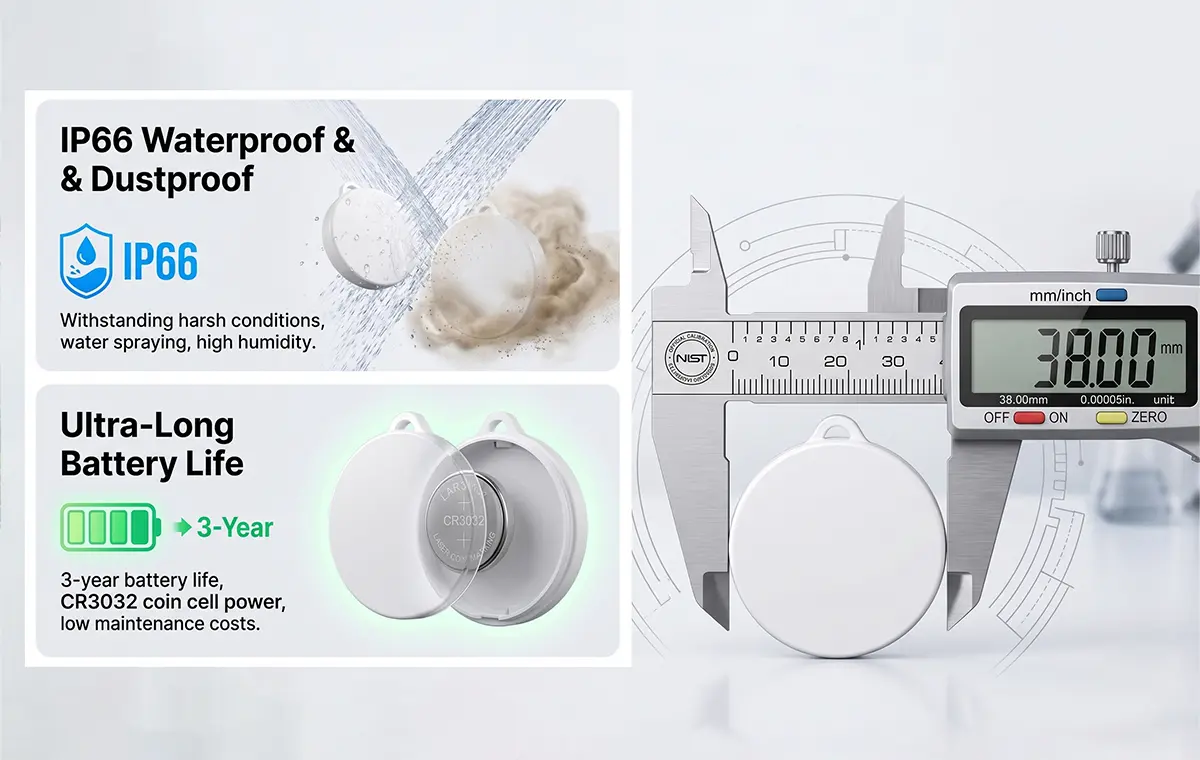
To address these difficulties, the agricultural base has adopted an intelligent IoT agricultural monitoring solution. Growers have deployed temperature and humidity beacons in different areas of the greenhouses. These beacons feature Bluetooth Low Energy (Ble) teknologi, a compact 38mm diameter (slightly larger than a US quarter), and a minimalist design. Each suar is bound to its specific monitoring point and connected to the base’s agricultural information system.
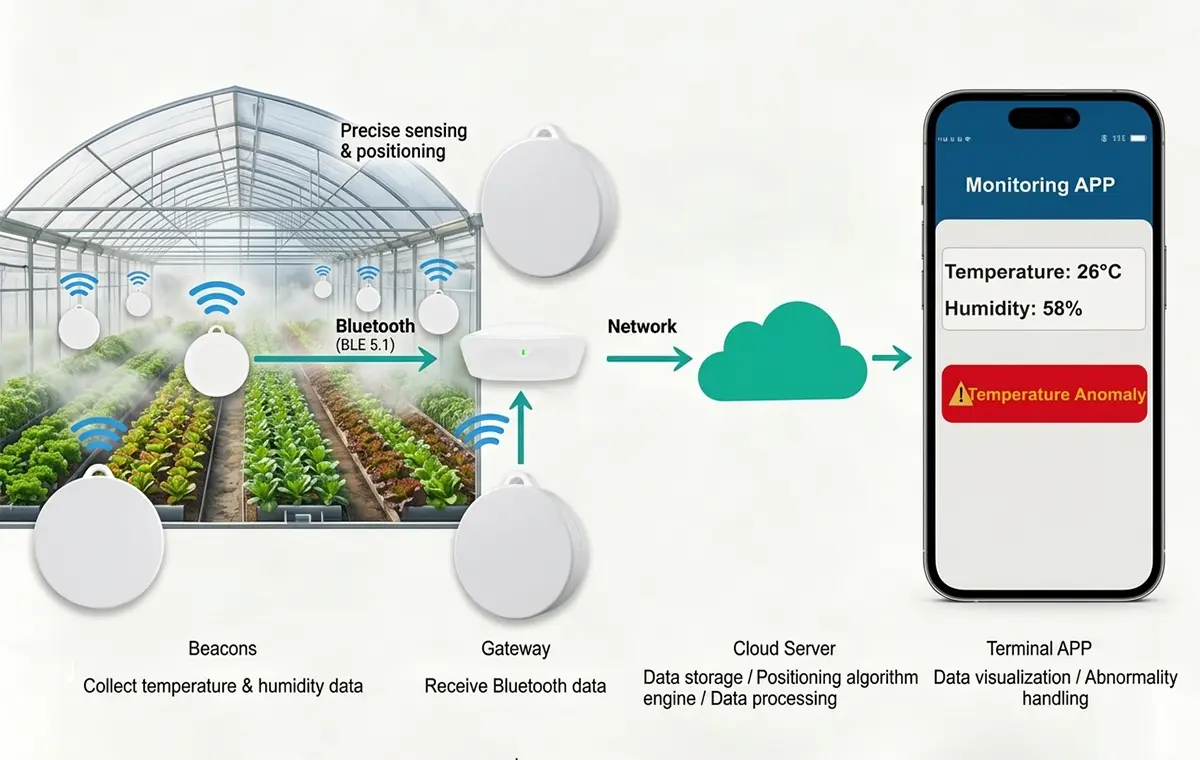
The Ble signals broadcast by the beacons carry real-time temperature and humidity data for their respective areas. These signals are uniformly collected by strategically deployed gateways and synchronously transmitted to the backend management system. Growers can view the real-time environmental status of the entire site through the management system without entering the greenhouses, achieving refined temperature and humidity control.
When the environmental temperature and humidity exceed the preset thresholds, the system automatically triggers an alarm and pushes alert notifications containing key information such as the location of the abnormal point and real-time temperature and humidity values to managers’ Peranti mudah alih. The gateways simultaneously upload the data to the monitoring system, which displays it on a visual dashboard, enabling managers to quickly formulate response measures. Leveraging IoT technology, the base has created a more stable and controllable crop growth environment, comprehensively improving the level of planting management.
Key Product
FSC-BP121 is a compact suar Bluetooth designed exclusively for environmental monitoring. It utilizes Bluetooth Tenaga rendah (Ble) 5.1 teknologi, delivering a temperature measurement accuracy of ±0.2℃ and humidity accuracy of ±2% RH. With IP66-rated water and dust resistance, it can easily withstand harsh conditions such as high humidity and water spraying in greenhouses. Powered by a CR3032 coin cell battery, it offers an exceptional battery life of up to 3 years under default settings, significantly reducing maintenance costs. This suar is ideal for environmental monitoring and intelligent control in scenarios including protected agriculture, cold chain storage, and laboratories.